From above
Secure the case vertically to practise within a deep enclosure, approaching the anastomosis from the top.
For a simulated deep common femoral artery exposure.
Anastomotic practice.
From open access to depth.
The St George’s Vascular Institute (SGVI) anastomotic simulator is a low-cost, fully 3D-printed trainer, with free plans for anyone who wants to make one.
View the model on MakerWorldModel link coming soon.
Change the setup to practise with open access or within a deep enclosure.
Four arms clamp multiple simulated vessels, adapting to your case.
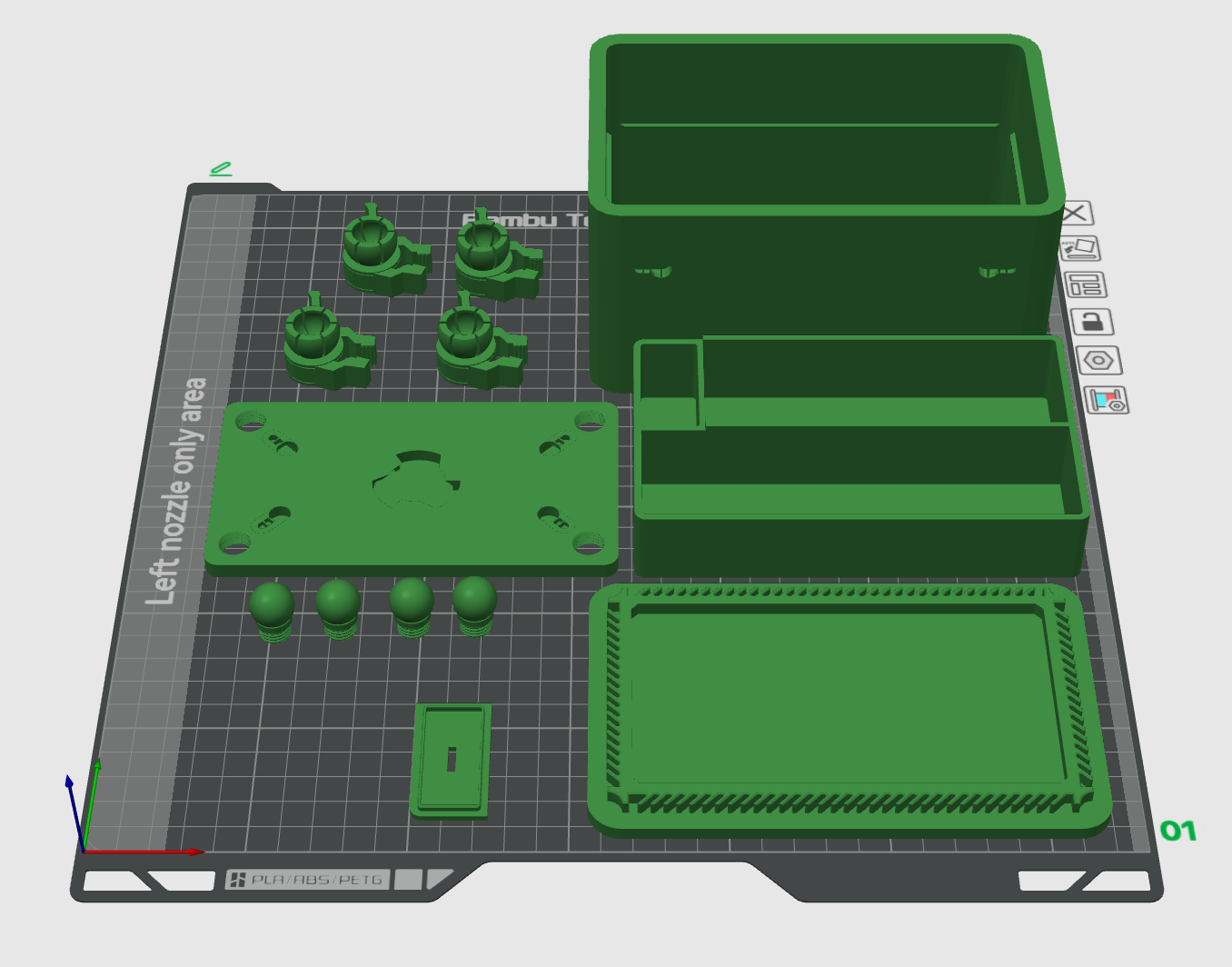
The case has an integrated tool chamber, a robust lid and a tool tray with an integrated sharps box. Suction cups on the sides and base secure the case in either orientation; the jig can also be used on its own.
Secure the case vertically to practise within a deep enclosure, approaching the anastomosis from the top.
For a simulated deep common femoral artery exposure.
Position the case horizontally to approach the anastomosis from the side, while retaining the depth of the enclosure.
For simulated below-knee anastomosis practice.
Remove the anastomosis jig entirely and secure it to a hard surface with suction cups.
An easier-access setup for earlier-stage trainees or for practising more complex skills.
Keep your instruments organised inside the case, with an integrated tool tray and sharps box.
Alongside the printed simulator, you’ll need instruments, suture, a simulated vessel and four small suction cups.
The system is designed around 14 cm Castroviejo needle holders, a pair of forceps and your suture of choice.
We have found silicone rubber tubing with a 5 mm inner diameter and a 0.3 mm wall thickness works well as a simulated vessel.
Use four small suction cups with approximately the following mounting dimensions, or similar:
James Budge
PhD MBBS FRCS
Academic Clinical Lecturer in Vascular Surgery
City St George’s, University of London
Vascular Surgery Registrar
I am a clinician and academic with an interest in surgical education and practical skills training. My work with the SGVI team on the anastomosis simulator brings these interests together, exploring how simulation can help trainees practise and refine surgical techniques.
I aim to connect clinical experience with academic enquiry to develop useful, accessible tools for surgical learning, and I am keen to hear from potential collaborators.
The model uses approximately 370 g of filament. At £10 per kilogram, that’s about £3.70 in filament, if you have access to a 3D printer. Plans are free for anyone who wants to make their own simulator.
MakerWorld link to be added.MAKERWORLD_MODEL_URL